


A $15 Billion Investment in Effingham County's Future
The proposed Effingham County Data Center Project is one of the largest economic development opportunities in our county’s
history — bringing high-paying jobs, significant property tax relief, and lasting support for our schools, roads, and community services.

$15B

350+

$80K

$32M+
Effingham County Data Center: Impact & Benefit Analysis
The proposed Effingham County Data Center Project represents a significant economic development opportunity that could bring substantial investment, high-quality jobs, and greater job diversity to the community.
The review process for this potential project has included collaboration and discussion among the Effingham County Industrial Development Authority, Effingham County Board of Commissioners, Effingham County School District, and other community partners to evaluate the project from multiple perspectives and better understand its potential impacts and opportunities.
Below is a detailed analysis of the project, its alternatives, and the broad range of benefits it offers to Effingham County, followed by a clear comparison chart summarizing key differences between the data center proposal and the warehouse alternative.
What Is Being Proposed?
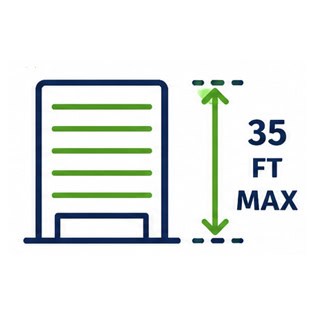
The proposed data center will be located in an industrial park and span 720 acres and consist of five buildings, each approximately 720,000 square feet, with building heights capped at 35 feet to minimize visual impact. Given that it is located in an existing industrial park it will have a significant buffer area. The project represents a minimum capital investment of $15 billion and is expected to be completed over a five-year period. The site benefits from direct access to Effingham Parkway, facilitating convenient employee commutes and logistical access.
Data Center Proposal
$15 Billion Investment

350+ High Paying Jobs

Minimal Impact

24/7 operations

Data Center’s Presence

720 Acres
5 Buildings
35 Ft Max

5 Years
Effingham Pkwy
What Does This Mean for Our Community?

High-Quality Jobs

School Funding

Low Traffic Impact

Sales Tax Revenue

Minimal Environmental Impact

Long Term Economic Growth
Transformative Support for Our Schools
without increasing the tax burden on families.
AI Career Pathway Program
technology — positioning Effingham County schools as STEM leaders.
New & Renovated Facilities
Attract & Retain Teachers
Expanded Programs
Tax Relief for Families
homestead owners helps keep families and seniors in the county, supporting stable enrollment.
Community Growth
Significant Increase in Funding:
Property Tax Relief for Homeowners:
Investment in Advanced Educational Programs:
Enhanced Facilities and Infrastructure:
Attracting and Retaining Quality Educators:
Support for Extracurricular and Special Programs:
Community Stability and Growth:
Long-Term Economic Benefits:
Comprehensive Benefits to Effingham County
Elimination of Homestead Property Taxes:
Reduced Taxes on Non-Homestead Properties:
Increased Housing Affordability:
Protection Against Tax Increases:
Support for Vulnerable Populations:
Stimulus for Local Economy:
Data Center vs. Warehouse Development
Data Center
600
Vehicle Trips/Day
Ware House
5100+
Semi-Truck & Vehicle Trips/Day
QUESTIONS & ANSWERS
Fair Questions Deserve Straight Answers
Our Commitment to Transparency: We believe every citizen has the right to the facts — not just the favorable ones. Where information is still being confirmed or commitments are not yet finalized, we say so directly. We will update this page as verified answers become available.
"The data center will strain our water supply."
Potable water use is limited to 30,000 gallons per day — comparable to a local hospital or car wash. Irrigation uses 50,000 gallons/day of recycled water,
not fresh water. The facility uses a closed-loop cooling system specifically designed to minimize daily water
consumption.
"Our electricity rates will go up because of the data center."
The data center will require approximately 2GW of power — a substantial demand addressed by a $2.5
billion expansion of Plant McIntosh, already underway. Georgia regulations require data centers to pay their full share of utility costs. We are confirming
with Georgia Power whether all relevant rate protections are fully in place, and will update this page with verified information.
"This will create a lot of noise and truck traffic in our neighborhoods."
The opposite is true compared to the alternative. A warehouse on this site would generate 5,100+ daily semi-truck trips. The data center, once built, generates only ~600 daily employee vehicle trips — with staggered shifts to avoid peak-hour congestion. The site is surrounded by industrial land on all sides, with no residential areas within half a mile.
"The environmental impact will be harmful."
The site’s highland terrain naturally reduces wetland disturbance. The facility uses half as many diesel backup generators as typical cloud data centers,
reducing emissions and noise. All environmental impacts are required to be mitigated per Georgia regulatory standards, and buffer zones minimize
visual and ecological disruption.
"The property tax benefits aren't guaranteed."
This is a fair point to raise. The county has stated its intent to use PILOT revenue for Project Zero tax relief,
but these commitments must be formally documented in writing before the ECIDA finalizes its position. Residents should expect — and hold their officials accountable for — written, binding commitments on all tax relief programs. This page will be updated as
agreements are formalized.
The land will be developed regardless — the question is: what’s built?
This site is zoned industrial and currently planned for warehouse development if the data center project does not proceed. Effingham County residents are not choosing between development and no development — they are choosing between a $15 billion technology investment with high-wage jobs and tax relief, versus a $740 million warehouse complex with thousands of daily truck trips and lower-wage employment.

County Revenue and Sales Taxes
- Estimated ? annual PILOT revenue for the county.
- Additional sales tax revenue from increased natural gas usage at the power plant and electricity consumption at the data center.
- These funds support five 1% sales taxes dedicated to school construction, road improvements, county capital projects, the general fund, and property tax relief.
QUESTIONS & ANSWERS
Effingham County, GA
Existing Industrial Park Adjacent to Effingham Parkway 4-sided industrial buffer zone
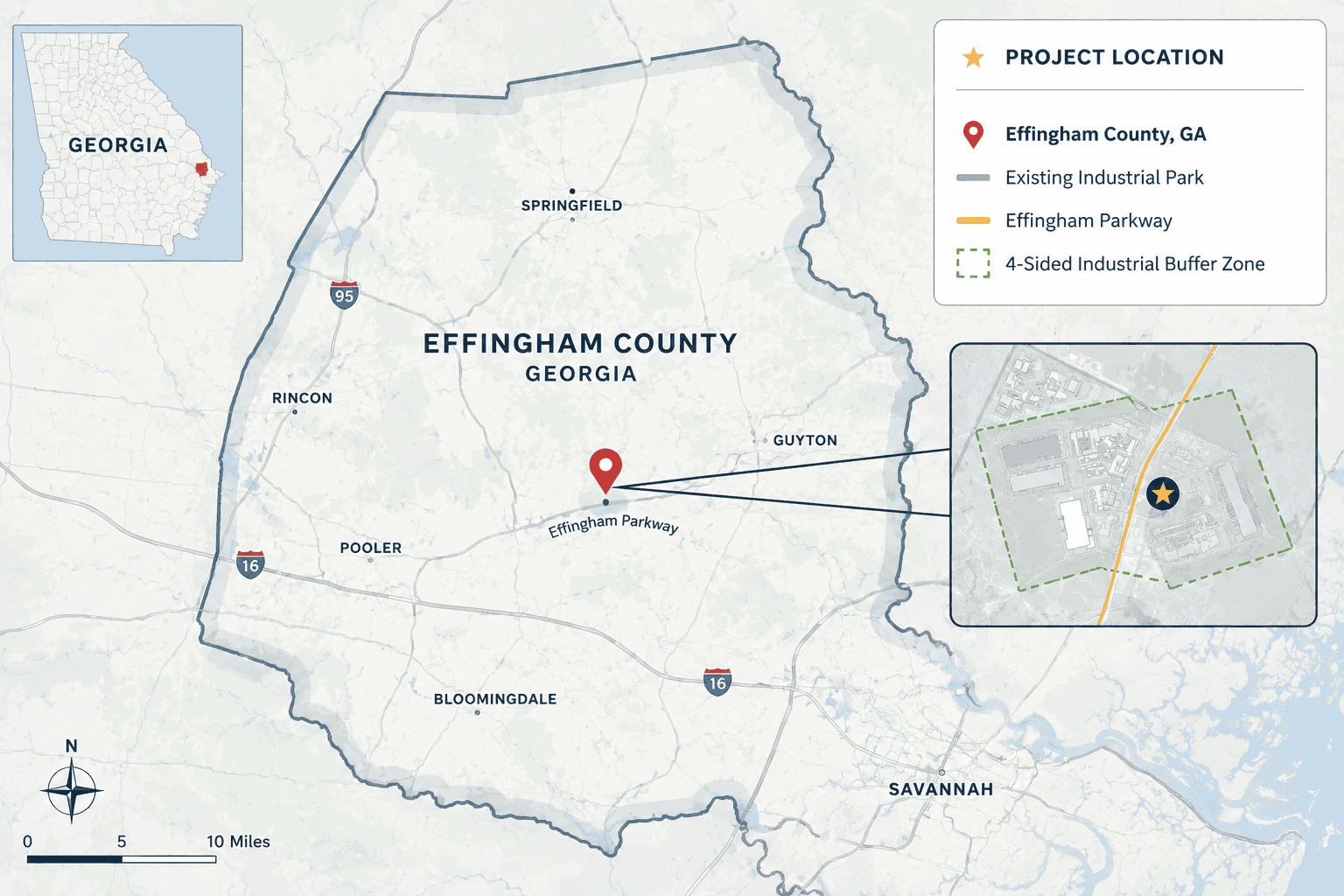
The site is within an established industrial park in Effingham County. The nearest residential area is at least ½ mile away. Industrial land surrounds all four sides.
QUICK FACTS
Who Has Been Involved
Ensuring this project is truly good for Effingham County has required input from many people. Leaders across our community have invested significant time researching and reviewing the potential impacts of this data center — examining everything from economic benefits to environmental concerns to utility demands.
Those involved in this process include:
- Effingham County Industrial Development Authority (ECIDA)
- Effingham County Government
- City Governments within Effingham County
- Effingham County School System
- Other Community Leaders & Stakeholders
This broad participation reflects a shared commitment to making decisions that serve all of
Effingham County — not just one group or interest.
Water Usage In Context
The facility’s daily potable water use of 30,000 gallons is roughly equivalent to a local hospital or large car wash. Irrigation uses only recycled water — 50,000 gallons/day — reducing fresh water demand. The closed-loop cooling system further minimizes consumption.
Issues to manage
Utility Demand
- The local power plant is also located in Effingham County and is undergoing a $2.5 billion expansion to support this demand. Not entirely true. Plant McIntosh is expanding already and there may be additional updgrades (in addition to the $2.5 billion) to support this project. I will confirm with Georgia Power.
- Georgia regulations ensure data centers pay their full share of utility costs and subsidize residential users. This needs to be verified with Georgia Power as I am not sure that the regulations are fully in place yet…
- The facility will use half as many diesel backup generators compared to typical cloud data centers, reducing emissions and noise.
- The data center will require 2GW of power, a substantial demand.
Water Usage
- Water usage will be about the same amount as the local hospital or car wash.
- Employs a closed-loop cooling system, minimizing daily water consumption.
- Potable water use is limited to 30,000 gallons per day.
- Irrigation will use 50,000 gallons per day of recycled water, reducing freshwater demand.
Environmental Impact
- The site’s highland terrain reduces wetland disturbance.
- Any environmental impacts will be mitigated according to regulatory requirements.
- The project’s design and buffer zones aim to minimize visual and ecological disruption.
Current Use Plan vs. Proposed Use Plan
If the data center were not being built on this land, the developer was expected to use the land for construction of new warehouse facilities.
The site is zoned industrial and surrounded by industrial land on all four sides, with the nearest residential area located at least half a mile away. This zoning allows for a variety of industrial uses including warehouse, manufacturing, and data centers.
- Planned development of 7.4 million square feet of warehouse and logistics space.
- Estimated $740 million capital investment.
- Approximately 600 jobs created, with an average annual salary of $_________.
- Expected to generate at least 5,100 semi-truck and vehicle trips per day on local roads, causing significant traffic congestion and noise.